
I use AI agents every day. However, I still pause when an agent asks me to sign in to one of my accounts.
I noticed this when I asked Grok Bot to scan my LinkedIn and X feeds. It had an X connector, but not one for LinkedIn. So, it opened LinkedIn on its cloud computer and presented a secure sign-in form. It told me that it would not see my password. After some hesitation, I signed in. Within five minutes, Grok Bot was reading both feeds and returning the original posts I wanted. But first, I had to decide how much I trusted the product.
I had the same experience when I started using Muse, Meta’s new personal AI agent. You describe what you want done, and it can use its own browser, fill out forms, send emails, make purchases, and continue working after you close the app.
I have been actively using Grok Bot and Muse for the last few days. Both are among the easiest consumer-facing agents I have used so far. The experience is very different from the setup and maintenance I have dealt with while running OpenClaw and Hermes over the last six months.
Using these products has helped me develop an intuition about how consumer AI agents may evolve.
The task depends on what I think the product can do
We build habbits out of the product we use everyday and these habbits develop a mental model for us on what kind of job-to-be-done belongs to what products.
When I open Google, I ask a question and expect information. When I open ChatGPT outside work, I might ask a similar question or ask it to analyze a document, write something, or work through an idea. With these tools, I expect to remain involved and steer the work.
When I open Grok Bot or Muse, I have a different expectation. I expect the agent to complete my task end to end. I do not want to babysit it. I am handing the responsibility for completing the task to the agent. However, the moment the agent opens a browser and asks me to approve an action, such as signing in to an application, I start treating it differently. I think about the risk and reward. That trust determines which accounts I connect and which actions I allow the agent to take.
Muse’s product design and their out of box integration with their social network helps me focus on the outcome. It asks the user to describe what they want without defining every step. For example, I can see myself asking Muse to schedule dinner with my friends when I visit Austin or turn a saved recipe into a grocery list. I expect Muse to figure out the workflow and return when it needs my approval.
Muse’s Ideas page also does a good job of showing non-technical users what they can ask it to do.
A 2x2 for AI products
I see these consumer AI products across two dimensions.
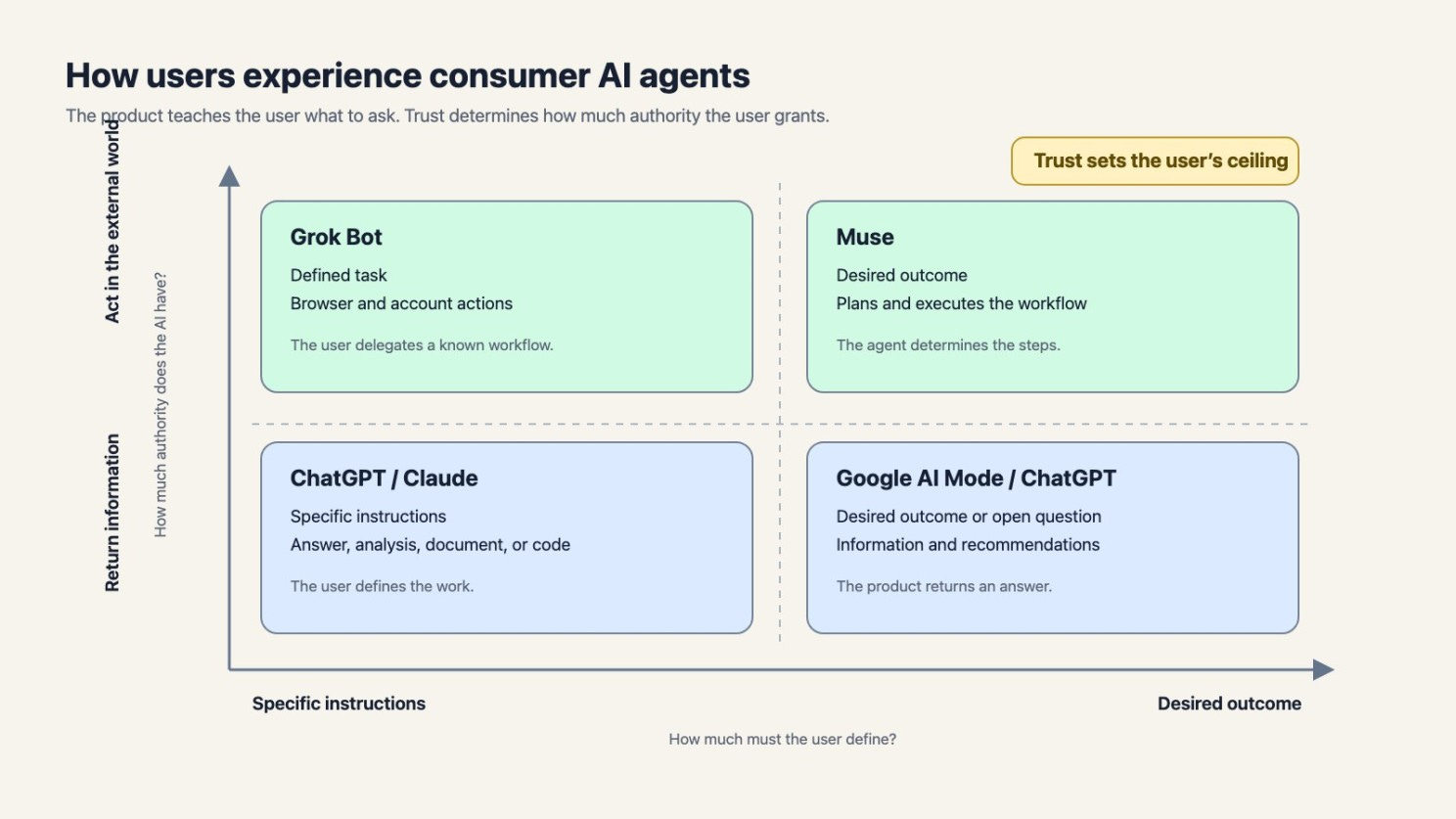
The horizontal axis is how much the user must define: specific instructions on one side and the desired outcome on the other.
The vertical axis is how much authority the AI has: returning information at the bottom and acting in the external world at the top.
This gives us four broad product experiences:
• ChatGPT or Claude helping with a document, analysis, or code: specific instructions and a work product.
• Google AI Mode or ChatGPT answering an open-ended personal question: a desired outcome, but the result is still information.
• Grok Bot scanning feeds or researching accounts: a defined task with permission to act.
• Muse coordinating plans, making reservations, or managing a personal project: a desired outcome with permission to act.
The products already overlap. I am describing the expectation each one currently creates for me. ChatGPT can perform an action, but I still often approach it with a question because that is how I have learned to use it.
Trust determines how much authority I grant
The 2x2 explains the task, but trust determines whether I will connect my Gmail account or allow an agent to send a message.
I may let an agent search the public web without thinking twice. Reading my email requires more trust. Allowing it to send email on my behalf requires even more.
My trust ladder currently looks something like this:
Search the public web and show me the sources.
Read information from an account I connect.
Draft something without sending or changing anything.
Make a reversible change after I approve it.
Send a message, book something, or make a purchase.
Continue working in the background without me watching every step.
Several correctly completed tasks may convince me to grant more access. One incorrect email or purchase will probably make me revoke that access quickly.
Existing platforms begin with different advantages
Trust is not the same across every part of my life.
I might trust Meta with my social graph because my Instagram, Facebook, and WhatsApp relationships already live there. I may be more comfortable giving Gemini access to Gmail and Calendar because Google already operates them. Microsoft has a similar position through Outlook and Teams. An active X user may trust Grok with a creator or small-business workflow.
Signing in to another website with Facebook does not automatically give Muse access to that account. The user still needs to connect the service and approve the permissions. However, a familiar identity and permission flow may reduce the friction of that decision.
OpenAI and Anthropic can connect to many of the same services, but they often have to establish trust with each connector. The other platforms begin closer to particular parts of the user’s context.
Once an agent has enough context, the user can give it less-defined goals. As the agent earns trust, the user may allow it to take more consequential actions. That is how a product moves toward the upper-right corner of the 2x2. (more automation and more trust)
The trust ladder leads to agentic commerce
I would probably not let a new agent book a flight on the first day. However, I could imagine letting Muse search Facebook Marketplace, compare listings, and prepare a message to the seller.
If it does that well, I may let it buy a movie or concert ticket after showing me the seat, date, price, and refund terms. Over time, I may allow it to book more expensive travel.
Meta says Muse can make purchases with approval. Its Stripe Link integration uses a one-time card, so the merchant does not receive the user’s actual card details.
But protecting my payment information is only one part of the decision. I also need to trust the agent’s judgment. Did it choose the right date, stay within my budget, and understand which flight I would choose instead of simply finding the cheapest one?
As the agent completes these tasks correctly, I may allow it to spend more. Platforms that already have the user’s context and payment relationship will have an advantage.
What product teams need to get right
The product must teach users which tasks it can complete, ask for access only when required, and show what it plans to do.
The first task should have a low cost of failure. Searching a feed or preparing a grocery list lets the user evaluate the agent before allowing purchases or bookings.
Approvals also need to appear at the right moments. Users should not have to approve every browser click, but they need to review the result before the agent sends, books, or buys anything.
Sources, completed steps, and account permissions should remain visible so the user can decide whether to grant more authority next time.
I do not expect one universal AI assistant
I have been using Grok Bot and Muse for the last few days and testing how they handle tasks that require account access and external actions. This is helping me understand which permissions I am comfortable granting now and what each product still needs to earn from me.
I expect to use different agents for different parts of my life. I may use Claude or ChatGPT to think and create, Google to answer a personal question, Grok Bot for work or to manage my X feeds etc.
Which accounts or actions would you trust an AI agent with today?